
Heart rate is one of the most widely used intensity metrics in endurance sport. It's on every watch, every chest strap and almost every training plan. It's also measuring something slightly different from what most athletes think.
Heart rate tells you how hard your heart is working. Lactate reflects the metabolic strain inside your muscles. Most of the time the two move together. At the intensities that decide training quality and race results, they can tell very different stories.

What heart rate actually measures
Heart rate is your cardiovascular system's response to demand. As effort rises, your heart beats faster to deliver oxygen to working muscles.
But your heart also responds to many things that aren't about your muscles' workload:
- Heat and humidity, as your body diverts blood to the skin to cool down
- Dehydration, which reduces blood volume and raises heart rate to compensate
- Caffeine, stress and poor sleep
- Fatigue accumulated over a long session
That's why the same pace can produce a noticeably different heart rate from one day to the next, even when your fitness hasn't changed.
What lactate actually measures
Your muscles produce lactate as they break down carbohydrate for energy, and your body clears it continuously. At easy intensities, production and clearance stay in balance and blood lactate stays low.
As intensity rises, two turning points appear:
- LT1, the first lactate threshold: lactate starts to rise above resting levels. Below this point, fat provides a large share of your energy, and your fat stores are practically unlimited.
- LT2, the second lactate threshold: lactate starts building faster than your body can clear it. Above this point, effort becomes unsustainable for long.
Lactate testing is one of the long-standing reference methods for setting endurance training zones. Exact threshold definitions vary between methods, which is why consistent testing matters.
What a real step test shows
Ultrarunner-turned-HYROX athlete Jake Dearden, a HYROX Pro Doubles world champion, ran an incremental treadmill test from 11 to 23 km/h, speeding up by 1.5 km/h each stage.
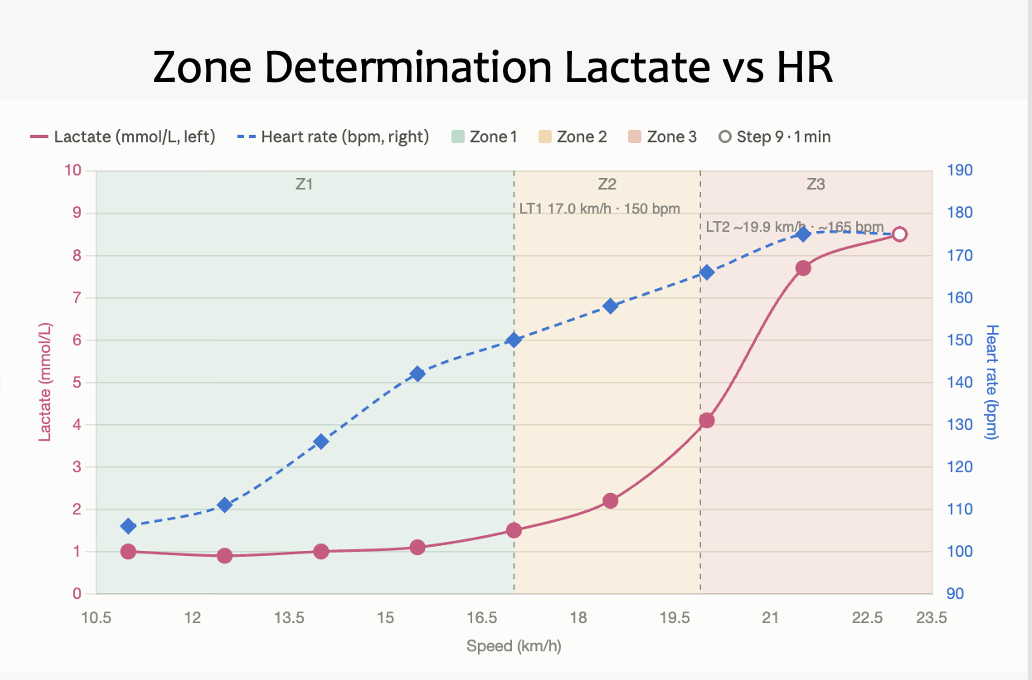
Watch the two lines.
Heart rate climbs step after step, but none of its bends line up with where lactate changes. Lactate stays flat until about 17 km/h, then bends upward, and rises steeply past about 20 km/h.
Three things stand out.
- The threshold range is only about 15 beats wide. LT1 sits at 17.0 km/h (≈1.5 mmol/L, 150 bpm) and LT2 at about 19.9 km/h (≈4 mmol/L, about 165 bpm). Everything between the two thresholds fits inside a 15 bpm window. Heat, dehydration and fatigue can shift heart rate by 5–10 bpm, enough to move an athlete across a large part of that range.
- Template zones could misclassify him. His LT1 heart rate is about 86% of the peak recorded in this test. Many 5-zone %HRmax models label that range zone 4. In other words, a template would treat the top of his aerobic range as threshold work.
- Heart rate compresses at the top. Above LT2, heart rate rises only about 10 bpm while lactate roughly doubles, from about 4 to 8.5 mmol/L. At interval intensities, heart rate struggles to separate hard from too hard.
Where heart rate breaks down in training
- Short intervals: Heart rate can take 1–2 minutes to catch up with the workload, so it understates the cost of the opening part of each rep. Athletes pacing to heart rate tend to start reps too hard and, as fatigue builds, ease off too much in later reps.
- Long sessions and heat: Cardiac drift can push heart rate up by 10 bpm or more at the same output, driven by heat, dehydration and fatigue. Heart rate caps can then make athletes back off more than the session requires.
- Group training: Max heart rate and threshold heart rate vary widely between athletes, so one heart rate band across a group can put some athletes on target and others a full zone away.
None of this makes heart rate useless. It remains a valuable tool for monitoring recovery, general load and steady efforts, as long as drift is taken into account. It's just answering a different question.
How elite programmes use lactate
- Build zones from your own thresholds. Set training zones from your LT1 and LT2, then express them in pace or power. Use heart rate as a secondary check rather than the primary target.
- Control threshold sessions by lactate. The Norwegian method, used by some of the world's most successful runners and triathletes, keeps threshold work inside a tight lactate range set for each athlete. It's designed to allow high volumes of quality work without excessive fatigue.
- Re-test every 6–8 weeks. A rightward shift in the curve usually signals aerobic adaptation, often before it shows up in race results. Keep fuelling and testing conditions consistent so the comparison is reliable. A curve that stops moving can be a signal to change the stimulus, unless the plateau is intentional, as in a taper.
The catch: measuring lactate is hard
Lactate testing has traditionally meant a lab or a portable analyser and repeated finger-prick blood samples. It's the established standard, but it's slow, invasive and difficult to repeat often. That's why many athletes test only a few times a season and rely on heart rate the rest of the time.
Measuring lactate without needles
We're building the PF-Sweat Patch to make lactate monitoring part of everyday training. A skin patch and wristband read lactate from your sweat during training and send it to your phone, with no finger pricks needed.
Sweat and blood lactate aren't the same number, so the patch is being validated against blood lactate testing to make sure it tracks the thresholds that matter.
The patch is still in development. Join the waitlist to be among the first to try it.