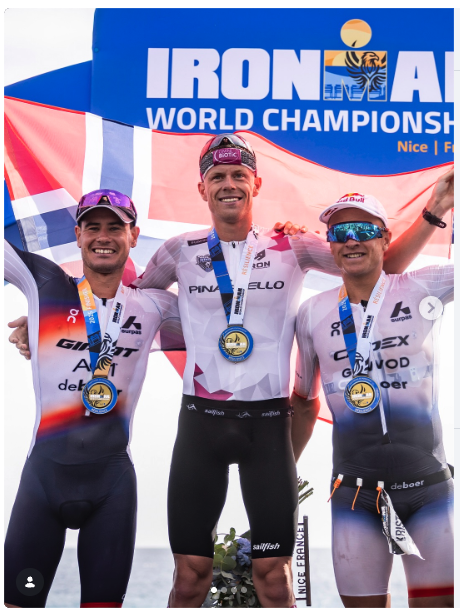
At the 2026 Ironman World Championship in Kona, the athletes who looked strongest early were not the ones standing at the end. Defending champion Solveig Løvseth led inside the final 8 km before she could barely walk, and Taylor Knibb passed her to win in 8:36:29. In the men's race, Magnus Ditlev came off the bike in the lead, then cramped and walked, while Vincent Luis moved up late to win in 7:47:27. The fastest marathon of the day, 2:36:57, came from Gustav Iden, despite a three-minute penalty on the bike.
Iden trains in the Norwegian group that has reshaped endurance sport over the past decade, using an approach built around one number: blood lactate. This article takes a closer look at that approach, often called the Norwegian method — where it came from, what a session actually looks like, why its targets are lower than most athletes expect, and why lactate-guided training is so well suited to long-course triathlon.
What is the Norwegian method?
The Norwegian method is an approach to endurance training that relies on physiological measurement rather than perceived effort or fixed pace targets. Its central idea is simple: instead of asking how hard a session feels, measure what the body is actually doing, and adjust in real time.
It was popularised in running by Marius Bakken, a Norwegian distance runner who refined the approach through thousands of lactate tests on himself. In triathlon, it was developed by Arild Tveiten, former head coach of the Norwegian Triathlon Federation, and Olav Aleksander Bu, who coaches Kristian Blummenfelt and Gustav Iden.
Bakken described the method as resting on two pillars:
- A high volume of low-intensity training, which builds the aerobic base.
- A substantial amount of work at lactate threshold, controlled precisely with blood lactate measurements.
Neither pillar is new on its own. What sets the method apart is how precisely the threshold work is controlled, and how much of it athletes are able to absorb as a result.
Inside a Norwegian threshold session
A Sweat Elite video gives a rare look at one of these sessions, with Blummenfelt, Iden and Aaron Royle on the track.
- The workout: 4 × 2 km followed immediately by 4 × 1 km, for 12 km of total threshold work.
- The recovery: 60 seconds between each interval.
The structure is deliberate. Instead of one long tempo run, the threshold work is broken into intervals. The short rests let athletes accumulate more total time at their target intensity while keeping lactate stable and fatigue under control.
Lactate as the governor
The defining feature of the session is what happens during those 60-second recoveries. Each athlete takes a small blood sample from a finger or earlobe and runs it through a portable lactate meter. Coaching guidance suggests sampling roughly 60–90 seconds after a repetition. The reading, not the stopwatch, dictates the workout:
- If lactate is above the target band, the athlete is running faster than intended and eases off, even on a day when they feel great.
- If lactate is below the target band, the athlete is not getting the intended stimulus and can pick up the pace.
Pace and power act as secondary controls. In one documented session, Blummenfelt took several blood samples during a 28 km climb and adjusted his running power between 380 and 400 watts to stay in his target zone. Even the sampling technique matters. Sweat on the skin can contaminate a reading, so it is wiped away first. Athletes also use the same site every time, because finger and earlobe values can differ.
Why go to all this trouble? Because feel is unreliable. Fresh legs, adrenaline, heat and caffeine can all make a pace feel easier, or harder, than it really is. Lactate gives an objective read on what the body is doing in that moment.
Why the targets are lower than you think
Many athletes have heard that the anaerobic threshold sits at 4 mmol/L of blood lactate. The Norwegians work lower.
- Olav Aleksander Bu has said his athletes' anaerobic threshold, defined as maximal lactate steady state, typically falls around 2.5–3.0 mmol/L.
- Marius Bakken's own target band was 2.3–3.0 mmol/L.
- Shorter intervals are sometimes run slightly higher, around 3.5 mmol/L.
The reason is fatigue. Keeping intensity just below the anaerobic threshold limits the build-up of hydrogen ions, which are released alongside lactate and lower muscle pH. Less acidity means less damage to recover from, so athletes can handle a far larger volume of threshold work and still be ready for the next session.
The counterintuitive result is that Norwegian hard sessions are deliberately less hard than most athletes would choose. The athlete who finishes a threshold workout feeling like they could do more is doing it right.
These numbers are specific to elite athletes. Thresholds vary from person to person, so anyone applying the method needs a lactate test to establish their own zones first.
How it fits into a training week
A track session like the one above is usually one half of a double-threshold day, with a second threshold session later the same day. Splitting the work this way lets athletes accumulate more threshold time than they could in one session, without the fatigue of a single long effort.
Bakken settled on two double-threshold days per week, plus one higher-intensity session he called the "X element." The rest of the week is dominated by easy, low-intensity volume.
The model has also evolved. Bu has said the group's training was largely threshold-focused leading into the Tokyo Olympics, but has since shifted toward a more base-focused, pyramidal distribution, where volume increases as intensity decreases. Even the Norwegians keep refining the method.
Why lactate-guided training works for Ironman
There is an apparent mismatch here. The Norwegian method focuses on the second lactate threshold (LT2), but an Ironman is raced near the first threshold (LT1), where lactate only starts to rise above resting levels. That distinction matters, because LT1 is the line that decides a long-course race. Below it, athletes rely mainly on fat, an almost unlimited fuel. Above it, carbohydrate use climbs sharply, and the body can store only a few hours' worth. A pace a few percent too hard feels fine in hour one and becomes a blow-up in hour seven.
So why does threshold-heavy training produce champions over 226 km? There are four main reasons.
- It raises the whole curve. Large volumes of controlled threshold work, combined with plenty of easy aerobic training, shift both thresholds to higher speeds and power outputs. When LT2 moves up, LT1 tends to move with it. The pace an athlete can hold while still burning mainly fat gets faster.
- It builds repeatable quality. Long-course performance depends on consistency over months. Because Norwegian threshold sessions are controlled to limit fatigue, athletes can repeat them week after week without the breakdowns that come from overreaching.
- It teaches intensity literacy. An athlete who checks lactate several times a session, year after year, learns exactly what each intensity feels like. On race day there is no meter, but that calibration remains. When rivals surge early, a Norwegian-trained athlete knows exactly how much it will cost.
- It reveals how conditions move the line. Regular testing shows how heat, fatigue and fuelling shift an athlete's thresholds. In Kona's humidity, heart rate drifts upward, blood is diverted to the skin for cooling, and carbohydrate use rises at the same output. A power target that sits safely below threshold in training can sit above it on race day. Athletes who understand this set smarter race targets.
Iden's 2:36:57 marathon in Kona this year is a good illustration. He did not win the race from the front. He ran the fastest marathon of the day after a penalty, because he still had something left when others had run out.
How age-group athletes can apply it
Most athletes do not have a lactate meter, a coach at every session, or 20+ hours a week to train. The good news is that the principles still apply. A simplified version keeps the core ideas and swaps blood lactate for more accessible markers.
- Test your thresholds first. A lab or field lactate test gives you a starting point. Without one, any target is a guess.
- Make your easy days genuinely easy. Most of your volume should sit below your first threshold. Most amateurs run their easy days too hard and their hard days too easy.
- Break threshold work into intervals. Short rests, such as 60 seconds, let you accumulate more quality time with less fatigue than one long tempo effort.
- Finish wanting more. If a threshold session leaves you wrecked, you went too hard.
- Use heart rate, power or effort as substitutes, with care. Heart rate drifts with heat, caffeine and fatigue, and perceived effort can mislead. Treat these as approximations, not equivalents.
- Re-test when conditions change. Your threshold in a cool spring block and in a humid summer block may not sit at the same pace.
What the science says
It is worth being honest about the evidence. Most of what we know about double-threshold training comes from coaching practice rather than controlled studies. Peer-reviewed work has described the model, but researchers note that scientific literature specifically supporting double-threshold training remains limited. The method's success among Norwegian runners and triathletes is well documented. Still, it is best viewed as one highly effective approach rather than a proven optimum.
Seeing your lactate without the finger prick
The biggest barrier to training the Norwegian way is not the method. It is the measurement. Finger-prick testing is invasive, interrupts sessions, gives only snapshots and is easy to get wrong. That is why most athletes fall back on heart rate and feel — the very signals that drift when conditions change.
We are building the PF-Sweat Patch to change that. A skin patch and wristband read lactate from your sweat and send it to your phone in real time, so you can see what is happening inside your body during training, without a single finger prick. The patch is still in development, and we are sharing progress with our waitlist first.
References
- Sweat Elite. Video featuring Kristian Blummenfelt, Gustav Iden and Aaron Royle (YouTube, 14 October 2022).
- Casado, A., Foster, C., Bakken, M., & Tjelta, L. I. (2023). "Does Lactate-Guided Threshold Interval Training within a High-Volume Low-Intensity Approach Represent the 'Next Step' in the Evolution of Distance Running Training?"
- INSCYD – How to Apply the Norwegian Method to Training
- Kelemen, B., Benczenleitner, O., & Tóth, L. (2023). The Norwegian double-threshold method in distance running: Systematic literature review.
- LetsRun (2023) – From Norway to Flagstaff
- TrainingPeaks – How the Norwegian Training Method Powers World Champion Triathletes
- High North Performance – The Norwegian Method of Training in Cycling
- Athletics Australia Coaching – The Norwegian Model of Lactate Threshold Training
- Triathlete – How to Train Like a Norwegian Without the Blood
- Comparison of acute physiological responses between one long and two short sessions of moderate-intensity training in endurance athletes (2024)
- Bakken, M. "The Norwegian model of lactate threshold training and lactate controlled approach to training." Blog post.