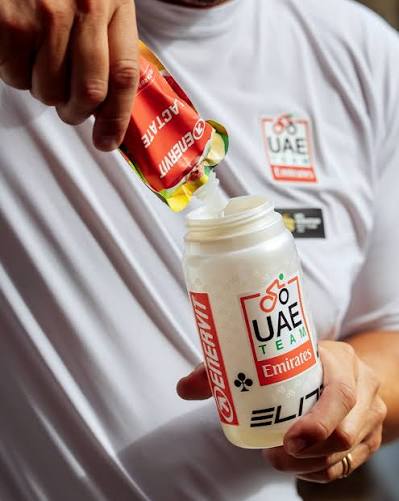
For decades, lactate was the villain of endurance sport. It was blamed for the burn in your legs and the fatigue that ended your race.
Then, at the 2026 Tour de France, some of the best cyclists in the world were reported to be fuelling with it.
Lactate gels are now one of the most talked-about products in endurance nutrition. Demand has grown so fast that one brand has launched unbranded packaging so pros can use it without clashing with their sponsors.
But before you add a new gel to your race belt, it's worth asking a simpler question: do you actually know what your own lactate is doing?
What are lactate gels, and why did the pros go for them?
A lactate gel delivers exogenous lactate, meaning lactate you swallow rather than lactate your muscles make. It's usually paired with a standard dose of carbohydrate, so it looks and works like a normal race gel.
The category broke through at the 2026 Tour de France:
- ExoLactate, a Basque brand, supplied gels combining 5 g of lactate with 40 g of carbohydrate. They were reportedly in demand from multiple WorldTour teams, and have also been used at races like the Western States ultramarathon.
- Tadej Pogačar and UAE Team Emirates worked with nutrition brand Enervit on a lactate-carbohydrate drink mix developed over two years with leading lactate scientist Professor George Brooks. It provides 90 g of carbohydrate and 10 g of lactate.
- More brands have since entered the space, and lactate is being called "the next ketones" of performance nutrition.
In November 2026, ExoLactate launched unbranded silver packaging so athletes could use it without upsetting team sponsors. That tells you how strong demand has become.
The science: why eat lactate at all?
The idea rests on something physiologists have understood for years: lactate is a fuel, not waste. Your muscles produce it, and other tissues, including your heart and other muscles, burn it for energy. This is known as the lactate shuttle.
It's not a small effect. In one study of men exercising at lactate threshold, about a third of the energy they got from carbohydrate came via blood lactate. When researchers raised blood lactate by infusion, the body burned more of it and spared muscle glycogen (source).
That's where the two proposed benefits of lactate gels come from:
- Extra fuel. If your gut can only absorb so much carbohydrate per hour, lactate might add energy through a different route.
- Buffering. Ingested lactate may act as a mild buffer, a bit like sodium bicarbonate, which could make hard efforts feel easier.
What the evidence actually shows
This is where it gets less exciting. The human performance research on lactate supplements is small and mixed:
- A 2011 study in trained cyclists found 120 mg/kg of lactate raised blood bicarbonate and improved time to exhaustion in high-intensity cycling.
- A 2014 study found no performance difference in a 40 km time trial, and no significant acid-base change after lactate ingestion.
- A 2024 trial using roughly 8 g of calcium lactate for a 70 kg rider found no time-trial benefit, despite raising bicarbonate and lowering perceived effort.
Even experts inside pro cycling are cautious. One Tour de France nutritionist said there is currently next to no data on whether ingested lactate gets through the gut, meaningfully changes blood lactate, or improves performance. Another team's head of performance has argued that until a hard ceiling on carbohydrate absorption is established, lactate remains a less efficient fuel than carbs.
Bottom line: the mechanism is real and promising, but the proof isn't there yet. Results are likely to vary from athlete to athlete.
Eating lactate vs measuring lactate
Lactate gels and lactate monitoring both put lactate at the centre of training, but they answer completely different questions. One adds fuel. The other tells you what your body is actually doing.
| Comparison | Lactate gels | Lactate monitoring |
|---|---|---|
| What it does | Adds lactate (plus carbs) as fuel | Shows how much lactate your body is producing and clearing |
| Question it answers | “Can I give my body more fuel?” | “How hard am I really working, and is my training working?” |
| Evidence base | Early and mixed in humans | Lactate testing has guided elite endurance training for decades |
| Works for | Long, hard efforts and races | Every session: easy runs, intervals, races and recovery |
| Personalised? | Same gel for everyone; response varies by athlete | Built around your own lactate curve and zones |
| Long-term value | Fuel for one effort | Tracks fitness gains over weeks and months |
They aren't rivals. If anything, monitoring makes fuelling smarter: you can't judge whether any new fuel works for you without knowing what your body is doing in the first place.
Why measuring comes first
Here's the irony of the lactate gel boom: elite athletes and teams experimenting with it typically have access to regular lactate testing. Most recreational athletes have never had their lactate measured at all.
For everyone else, knowing your lactate answers the questions that matter long before fuel does:
- Are my easy days actually easy? Most runners and riders drift into a "grey zone" that's too hard to recover from and too easy to improve from.
- Where are my real thresholds? Generic heart-rate zones are estimates. Your lactate response is yours.
- Is my training working? As you get fitter, you can go faster before lactate starts building. That shift is one of the clearest signs of progress.
- Is a new fuel worth it? To judge any new fuelling strategy fairly, you need to compare sessions done at the same true intensity.
The problem has always been access. Traditional lactate testing means finger-prick blood samples, stopping mid-session and, usually, a lab or coach with the equipment.
Where the PF-Sweat Patch fits
The PF-Sweat Patch is designed to bring lactate out of the lab and into everyday training:
- Needle-free: an ultra-thin skin patch and wristband read lactate from your sweat, so there are no finger pricks and no stopping.
- Continuous: data streams to your phone as you move, so you see where you're heading during a session, not just where you were.
- Built around zones: readings map to PointFit's 4-zone training model, so the numbers turn into clear decisions.
- Validated: clinically validated against blood lactate testing, the gold standard.
- Recognised: named a CES 2026 Innovation Awards Honoree in Digital Health.
Lactate gels might become a useful tool for some athletes. But the bigger shift is knowing your own lactate in the first place.
Key takeaways
- Lactate is a fuel your body already uses heavily. That's the solid science behind the gel boom.
- Lactate gels are promising, but human performance evidence is still early and mixed.
- If you try one, test it in training first. Responses vary from athlete to athlete.
- Knowing your own lactate (your zones, your thresholds, your progress) helps every session, with or without a new gel.
Want to see your lactate in real time? Join the PF-Sweat Patch waitlist to be among the first to train with it.
Sources
- Tour de France riders are using a secretive new fueling solution (Velo)
- Pogačar is using a powerful new lactate fuel at the Tour de France (Velo)
- Lactate gels go undercover (Velo)
- Are lactate gels already old news? (Escape Collective)
- Lactate gels at the Tour de France: what the research actually supports (Styrkr)
- Tour de France triggers interest in exogenous lactate: what does the research say? (NutraIngredients)
- Lactate is now powering Pogačar at the Tour de France (BikeRadar)
- Effects of lactate consumption on blood bicarbonate levels and performance (IJSNEM, 2011)
- Northgraves et al., sodium bicarbonate and lactate in 40 km time trials (JSCR, 2014)
- Study of lactate oxidation in trained and untrained men at lactate threshold (PMC)
- PF-Sweat Patch, CES 2026 Innovation Awards honoree (CES)